
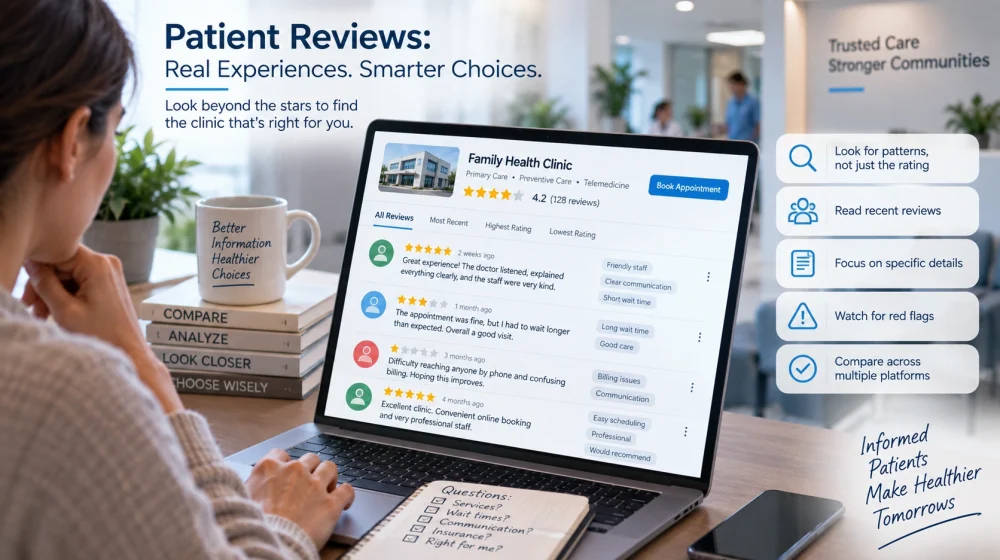
Patient reviews have become an important source of information for people choosing a clinic, doctor, or other healthcare provider. However, a high or low star rating rarely tells the complete story because individual experiences can vary widely and reviews often focus on only one part of the patient journey. Reading feedback critically can help patients identify meaningful patterns while avoiding decisions based on isolated complaints or exaggerated praise.
Why patient reviews can be useful but also misleading
Patient reviews can reveal practical aspects of healthcare that are difficult to understand from a clinic’s website, but they should not be treated as an objective measure of medical quality. Reviews can provide valuable information about appointment scheduling, waiting times, communication, staff behavior, billing procedures, and the overall organization of a practice.
At the same time, every review reflects an individual experience. A patient may leave a negative rating because of a long wait even if the medical care itself was appropriate. Another person may give five stars primarily because the staff were friendly. Neither review necessarily tells future patients how qualified the clinician is or whether treatment decisions follow appropriate medical standards.
What to look for beyond the overall star rating
The most useful information is usually found in the content and consistency of reviews rather than the average score displayed at the top of the page. Several signals can provide a more balanced picture of a clinic.
- Number of reviews. A rating based on hundreds of experiences generally provides more context than a perfect score based on only a handful of reviews.
- Recent feedback. Newer reviews may better represent the clinic’s current staff, procedures, scheduling practices, and patient experience.
- Repeated themes. Similar comments from unrelated patients can reveal consistent strengths or weaknesses.
- Specific descriptions. Reviews explaining what happened are generally more informative than comments that simply say a clinic was “great” or “terrible.”
- Balance of experiences. Reading positive, neutral, and negative reviews can provide a more complete picture than focusing exclusively on one category.
A clinic with a slightly lower rating but hundreds of detailed, generally positive reviews may provide more useful evidence than one with a perfect score and very little feedback.
How to tell an isolated complaint from a recurring problem
Patterns across multiple independent reviews matter considerably more than a single negative experience. Almost every healthcare organization will eventually receive criticism. Appointments can run late, misunderstandings occur, and individual interactions do not always meet patient expectations.
Instead of asking whether negative reviews exist, examine whether different patients repeatedly describe the same problem. If one person complains about waiting 30 minutes, that may be an isolated event. If many recent reviews consistently mention unusually long waits, frequent cancellations, billing confusion, or difficulty contacting staff, the issue deserves more attention.
Dates are important as well. A cluster of complaints from several years ago may no longer reflect current operations, especially if more recent feedback indicates improvement.
Which details in patient reviews are actually worth paying attention to
Reviews are most valuable when they describe observable aspects of the patient experience rather than attempting to judge complex medical decisions. Certain details can be particularly useful when comparing clinics.
- Communication. Look for comments about whether clinicians listen, answer questions, and explain information clearly.
- Scheduling and waiting times. Reviews can reveal how easy appointments are to arrange and whether significant delays occur regularly.
- Staff professionalism. Repeated observations about respectful, organized, and helpful staff can provide useful insight into the clinic’s environment.
- Billing transparency. Comments about unexpected charges or unclear payment procedures may be worth investigating before booking.
- Follow-up care. Feedback about receiving test results, returning messages, prescription requests, and coordinating further appointments can indicate how the clinic handles care after the initial visit.
These are areas patients can directly observe and compare. Clinical outcomes are usually much more difficult to evaluate accurately through online reviews alone.
Red flags that may make a patient review less reliable
Reviews containing extreme claims without specific context should generally be interpreted cautiously. Very emotional language, broad accusations, or statements that provide almost no detail may tell readers little about what actually happened.
Similarly, unusually enthusiastic reviews filled with promotional language may not provide much useful information. A large number of nearly identical reviews posted within a short period can also deserve additional scrutiny.
Patients should be particularly careful with reviews that confidently declare whether a diagnosis or treatment was medically correct. Without access to the complete medical history, examination findings, test results, and clinical reasoning, other patients usually cannot verify such claims. Reviews are better suited to evaluating patient experience than determining professional competence.
What a clinic’s response to negative reviews can reveal
How a clinic responds to criticism can sometimes be as informative as the negative review itself. A professional response may acknowledge the patient’s concern, explain general policies where appropriate, and provide a way to discuss the issue privately.
Responses that are aggressive, dismissive, argumentative, or insulting can raise concerns about communication standards. Clinics should also be careful about patient privacy and avoid publicly discussing confidential medical information when responding to online criticism.
At the same time, clinics cannot always explain their side of a dispute publicly because healthcare privacy rules may limit what they can disclose. A brief response should therefore not automatically be interpreted as avoiding responsibility.
How to compare reviews across different platforms
Checking more than one source can reduce the risk of forming an opinion from an unusually positive or negative collection of reviews on a single platform. Different websites may attract different groups of patients and use different moderation or rating systems.
- Check several sources. Compare reviews on major search platforms, healthcare directories, and other reputable websites where relevant.
- Compare recurring themes. Look for the same strengths or complaints appearing independently across multiple platforms.
- Pay attention to dates. Give greater weight to recent experiences while considering whether older complaints still appear today.
- Compare the overall pattern. Consider review volume, detailed comments, recurring issues, and the clinic’s responses rather than simply comparing numerical ratings.
If feedback differs dramatically between platforms, examine the actual comments to understand why rather than assuming that one rating must be correct.
How to use patient reviews when making your final decision
Patient reviews should be treated as one piece of evidence rather than the deciding factor when selecting healthcare. Use them alongside information about clinician qualifications, available services, location, insurance participation, costs, appointment availability, and the clinic’s professional credentials.
Reviews are particularly helpful for developing questions to ask before booking. If several patients mention billing confusion, ask the clinic to explain its payment policies. If scheduling appears difficult, ask about typical appointment availability. If communication receives consistent praise, that may be a meaningful advantage for patients who value ongoing contact with their healthcare team.
The goal is not to find a clinic with no negative feedback. Such a standard is unrealistic for any organization serving a large number of people. Instead, look for a consistent pattern of professional communication, reliable organization, transparency, and positive patient experiences. When reviews are read critically and combined with objective information about the provider, they can become a useful tool for making a more informed healthcare decision.