
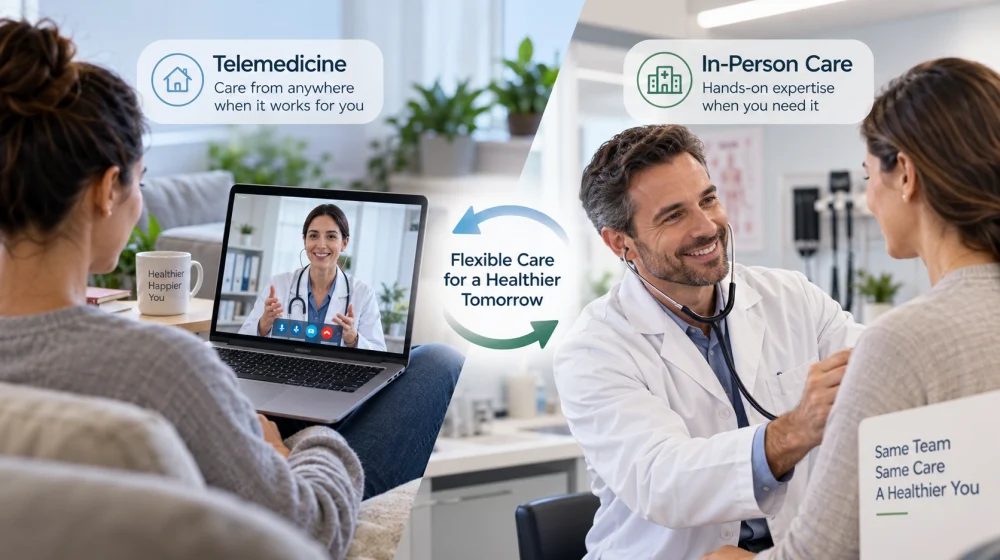
Healthcare is no longer limited to the traditional model in which every medical concern requires a trip to a clinic. Modern providers increasingly combine virtual consultations with face-to-face appointments, creating a flexible system in which patients can receive care in the format that best matches their needs. Neither approach is ideal for every situation, but a well-designed hybrid model can improve convenience and access without compromising the quality of medical care.
How telemedicine and in-person visits differ in practice
The main difference between telemedicine and an in-person visit is the way a healthcare professional can evaluate the patient and collect clinical information. During a virtual appointment, communication usually takes place through video, phone, or a secure digital platform. Patients can describe symptoms, discuss medications, review test results, ask questions, and receive recommendations without traveling to a medical facility.
An in-person appointment provides the clinician with additional diagnostic possibilities. A doctor can perform a physical examination, check vital signs directly, listen to the heart and lungs, examine a painful area, or conduct procedures that cannot be completed remotely. For this reason, the choice between telehealth and office visits should depend primarily on the patient’s condition rather than convenience alone.
When telemedicine is the better option for patients
Virtual care works particularly well when the medical issue can be assessed through conversation, visual observation, existing health information, or follow-up monitoring. It can save patients considerable time and make routine healthcare easier to fit into everyday life.
- Follow-up consultations. Patients can discuss recovery, medication effects, or changes in symptoms after a previous appointment without returning to the clinic unnecessarily.
- Reviewing laboratory and imaging results. A physician can explain findings, answer questions, and discuss the next steps through a secure video consultation.
- Medication management. Telemedicine may be appropriate for reviewing how prescribed treatment is working and discussing possible side effects or adjustments when a physical examination is not required.
- Minor or familiar health concerns. Some symptoms can initially be evaluated remotely, allowing a clinician to determine whether home care, further testing, or an office appointment is appropriate.
- Patients with travel or mobility difficulties. Virtual appointments can reduce transportation barriers for people who live far from a clinic, have limited mobility, or have difficulty taking time away from work or family responsibilities.
Telemedicine can also provide an efficient first point of contact. Even when a virtual consultation cannot resolve the problem completely, it may help determine what type of care the patient needs next.
When an in-person appointment is still necessary
Face-to-face medical care remains essential whenever diagnosis or treatment depends on a physical examination, procedure, testing, or immediate clinical assessment. Symptoms such as significant injuries, severe or rapidly worsening pain, breathing difficulties, or other potentially urgent problems generally require direct evaluation rather than relying exclusively on a remote consultation.
In-person visits are also necessary for many diagnostic procedures, vaccinations, wound care, physical examinations, and tests that require specialized equipment. A virtual appointment cannot reproduce everything a clinician learns by examining the body directly. When there is uncertainty about the seriousness or cause of symptoms, a provider may begin with telemedicine but recommend an office visit for a more complete evaluation.
How modern clinics combine both formats in one care pathway
Instead of treating virtual and in-person care as competing services, many clinics can use them as different stages of the same patient journey. This approach allows routine interactions to take place remotely while preserving physical appointments for situations in which they provide meaningful clinical value.
- Initial assessment. A patient may begin with an online consultation in which the clinician reviews symptoms, medical history, medications, and other relevant information.
- Decision on next steps. If the issue can be handled remotely, the clinician provides recommendations or follow-up instructions. If physical assessment is needed, an office appointment is arranged.
- In-person examination or testing. The patient visits the clinic for procedures, diagnostic tests, physical examination, or treatment that cannot be performed virtually.
- Remote follow-up. After the examination or treatment, subsequent conversations may return to telemedicine for progress checks, discussion of results, or ongoing management.
This integrated process can reduce unnecessary clinic visits while maintaining continuity. Ideally, information from both formats remains within the same medical record, so clinicians can see what happened during previous virtual and face-to-face interactions.
The benefits of a hybrid model for patients and clinics
A hybrid healthcare model can make care more accessible and efficient while allowing clinicians to reserve in-person resources for patients who genuinely need them. The value comes not from replacing traditional medicine with technology, but from using each format where it works best.
- Greater convenience. Patients can complete appropriate consultations from home or work and avoid travel, parking, and waiting-room time.
- Improved access. Telemedicine can connect patients with healthcare professionals even when distance, mobility, or scheduling makes regular clinic visits difficult.
- More efficient use of appointments. Routine follow-ups and discussions can move online, leaving more office capacity for examinations and procedures.
- Better continuity of care. Easier follow-up may help patients stay in contact with their healthcare team instead of postponing appointments because attending the clinic is inconvenient.
For clinics, this flexibility can also improve scheduling and help organize care around the actual requirements of each case. For patients, it creates more options without removing access to traditional medical services.
What patients should consider when choosing between telemedicine and an in-person visit
The most important question is not which format is generally better, but which one is appropriate for the specific medical concern. Patients should consider the nature and severity of their symptoms, whether a physical examination may be necessary, and whether diagnostic tests or procedures are likely to be required.
Privacy and technology also matter. A telemedicine appointment requires a suitable device, reliable internet or phone access, and a private environment where personal health information can be discussed comfortably. Patients should also consider whether they can clearly describe or show the relevant symptoms remotely. When uncertain, contacting the clinic can help determine the appropriate type of appointment.
Convenience should never override urgent medical needs. Symptoms that may indicate a medical emergency require appropriate emergency evaluation rather than waiting for a routine virtual or office consultation.
What the future of hybrid healthcare may look like
The future of healthcare is likely to involve increasingly connected systems in which digital and physical care operate as parts of one continuous experience. Remote monitoring devices, electronic health records, patient portals, wearable technology, and improved video platforms may allow clinicians to collect more useful information between traditional appointments.
A patient might complete an initial consultation remotely, receive testing at a clinic, review the results online, and then return for an in-person examination only when necessary. At the same time, clinicians may use remotely collected information to monitor chronic conditions and identify changes that require further attention.
Telemedicine is therefore unlikely to eliminate the need for medical offices. Instead, the strongest model is one in which technology removes unnecessary barriers while preserving direct clinical care whenever physical examination, testing, procedures, or personal interaction are important. By combining both formats thoughtfully, modern clinics can offer healthcare that is more flexible, accessible, and responsive to individual patient needs.